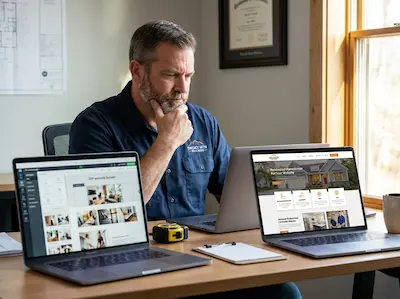
Your home services business needs a website built, but you're staring down two very different paths: spend the weekend wrestling with a DIY builder or write a check to a professional designer. Both will get you online. Only one will actually get you leads.
The DIY pitch sounds tempting. Most plans cost between $15 and $50 a month for popular builders like Wix or Squarespace. Compare that to $2,000–$10,000 for a professional, high-converting site, and it's easy to see why so many contractors reach for the builder.
Here's what those marketing emails don't mention: you're going to pay either way. The question is whether you pay upfront for results, or slowly bleed revenue from a site that looks fine but converts poorly.
The Real Cost of DIY (Hint: It's Not $20 Per Month)

That monthly subscription is just the entry fee. DIY website projects take 3-6 months of part-time work, spread over 190-400 hours of your evenings and weekends. If you typically bill $75 per hour for your roofing or HVAC work, that DIY site just cost you $14,000-$30,000 in lost income.
And that's assuming everything goes smoothly. Most business owners try DIY website building 2-3 times before calling a professional, multiplying both the time investment and frustration.
The hidden costs stack up fast. You're going to pay for that cheap site anyway—in lost leads, wasted staff time, broken tech, and a steady erosion of trust. In 2026, with AI search and higher user expectations, those hidden costs stack up even faster.
Your cousin might build websites "on the side," but getting mates rates doesn't guarantee results. We've compared the DIY option with the agency option — and the numbers tell a clear story.
Why Most DIY Contractor Sites Don't Generate Leads

The biggest issue isn't how your DIY site looks. It's how it performs. Most websites only convert at an average of 0.5%. This is extremely low! Meanwhile, across home services, average website conversion rates sit around 7.8%. Plumbing sites with clear service explanations routinely hit 12–16%, while vague roofing sites often struggle between 3–7%.
Same traffic. Wildly different results.
Take the DIY approach, which will save you money but you won't get leads as you will be on page 7 of search results. Google doesn't care how pretty your site looks if it can't find it. DIY platforms often get the technical setup for local SEO wrong. Performance optimization is crucial because page speed and mobile-first design are huge factors in Google's ranking. A slow site doesn't just annoy visitors; it gets penalized by search engines.
The conversion problems run deeper than SEO, though. Rotating sliders, abstract headlines, or clever taglines feel modern, but they slow decisions. Many contractor website design trends focus on visual polish. Conversion-focused sites focus on clarity and repetition. If a homeowner has to scroll just to confirm you do what they searched for, the page has already failed.
If your website looks like a throwaway side project, people subconsciously assume your business or nonprofit is also small, fragile, or temporary—even when it's not.
What Professional Web Design Actually Gets You
A professional doesn't just build a prettier website. They build a lead-generation machine. This is stuff that just doesn't come with a DIY builder.
The numbers prove it. One professional home service provider went from a 1.5% conversion rate to over 5% with a few focused changes. Most builders with a passive site convert at 0.5%, but clients regularly see conversion rates above 10% when using a landing page campaign specific to the inbound source.
Here's what separates professional builds from DIY templates:
Strategic Structure: The best contractor websites do not behave like traditional marketing pages. Instead, they function as digital dispatch centers designed to convert urgent homeowner needs into booked service jobs.
Local SEO Foundation: This means making sure your site is built to show up when people search for "plumber in Gilroy" or "roofing contractors in Salinas." It's a technical setup that DIY platforms often get wrong.
Conversion-Focused Design: This is about strategy. It's putting click-to-call buttons where they'll get used and featuring trust signals like reviews and project photos right where customers need them.
75% of users judge your company's credibility based solely on your design. A professional build isn't a bill; it's a revenue engine.
The ROI Math That Changes Everything
In 2026, a strategy-driven website typically costs between $8,500 and $12,000. While that might seem higher than a DIY monthly subscription, consider that 75% of users judge your company's credibility based solely on your design. A professional build isn't a bill; it's a revenue engine.
Let's run the numbers. Say your current DIY site gets 300 visitors per month with a 1% conversion rate — that's 3 leads. The construction industry has a very low average website conversion rate, usually between 2.4% and 4.1%. With your new site, even a small improvement makes a huge difference. Let's say your new conversion rate is just 2%—still low, but double what you had. New situation: 300 visitors/month x 2% conversion rate = 6 leads per month. Just like that, you've gained three extra leads every month without spending more on ads.
If you close just one of those three new leads, and your average roofing job is worth $8,000, you've generated an additional $8,000 in revenue that month. In this scenario, a professional website that costs, say, $8,000 pays for itself in the first month.
If a custom, well-designed site converts just 2–3 extra visitors a week into clients, sales, or donors, the ROI over a year dwarfs the "savings" from a cheap builder.
Meanwhile, you're still spending those 400 hours on customer service, job site management, and business development instead of learning CSS.
When DIY Makes Sense (And When It Doesn't)
The U.S. Small Business Administration recommends DIY builders for startups on tight budgets, noting that hosting, security, and software fixes come handled by the platform. If you're just starting out, testing a concept, or genuinely can't access $8,000 in capital, DIY gets you online fast.
But if you're established and serious about growth? Your technical comfort, available hours, and growth stage matter more than price when choosing between DIY and professional small business web design packages.
The math gets worse as you scale. A safe rule of thumb is to budget 10-15% of your initial build cost for annual maintenance. For a DIY site, this will mostly be your renewal costs for hosting and plugins ($100 – $500). For a site built by an agency for $15,000, you should budget at least $1,500 per year for hosting, licenses, and professional support.
That professional maintenance? It's worth every penny when a plugin breaks during peak season and you need it fixed in hours, not days.
Your website isn't a digital brochure. It's your hardest-working employee, pulling in qualified leads 24/7. The question isn't whether you can afford professional web design. It's whether you can afford to keep losing leads to competitors who invested in theirs.
FAQ
How long does it really take to build a DIY contractor website?
Most DIY website projects take 3-6 months of part-time work, spread over 190-400 hours of evenings and weekends. That's assuming everything goes smoothly and you don't need to start over.
What's the average conversion rate for home services websites?
Across home services, average website conversion rates sit around 7.8%. Plumbing sites with clear service explanations routinely hit 12–16%, while vague roofing sites often struggle between 3–7%. Most DIY sites convert closer to 0.5%.
Can I start with DIY and upgrade to professional later?
Yes, but if you stop using that particular DIY platform, you have to start over again somewhere else. You can't take your site with you. It's usually more cost-effective to build it right the first time.
How much should I budget for a professional contractor website?
Most small businesses land in the $2,000–$10,000 range for a professional, high-converting site. A strategy-driven professional web design project typically costs between $8,500 and $12,000. For entry level professional sites, expect to invest between $5,000 and $7,000.
Will a professional website really pay for itself?
If you close just two of five new monthly leads, and your average roofing job is worth $8,000, you've generated an additional $16,000 in revenue that month. A professional website that costs $8,000 pays for itself twice over in the first month — if it's built to convert.